A drawn preview
What playing here should feel like — drawn, not running
Everything on this page is a static picture assembled from real pieces. The
world really did come out of the map generator that runs in development — seed
freehold-one, 28 by 18, connectivity-checked — but the view shows
only what the character can see: their vision radius, five squares in
every direction, all of it fully displayed, with the character centred. That is
the owner’s direction for how the client presents the world, recorded in
the design repository; the radius number itself is still an open balance
question. The art is the project’s own
painted library. The character, the wolf and every number in the panels are
invented sample data, baked into the page.
Still not a game. Nothing on this page is clickable into anything. The chips are not buttons, the queue is not a queue, and this site still cannot open a connection to a server, because there is no server. When the real client ships, it ships at this address — this page is what it is aimed at.
No Mana bar: this character cannot cast, and a bar for a resource you do not have is a promise the game does not intend to keep.
A maintained road. Passable. The label and the description are the served legend’s own words.
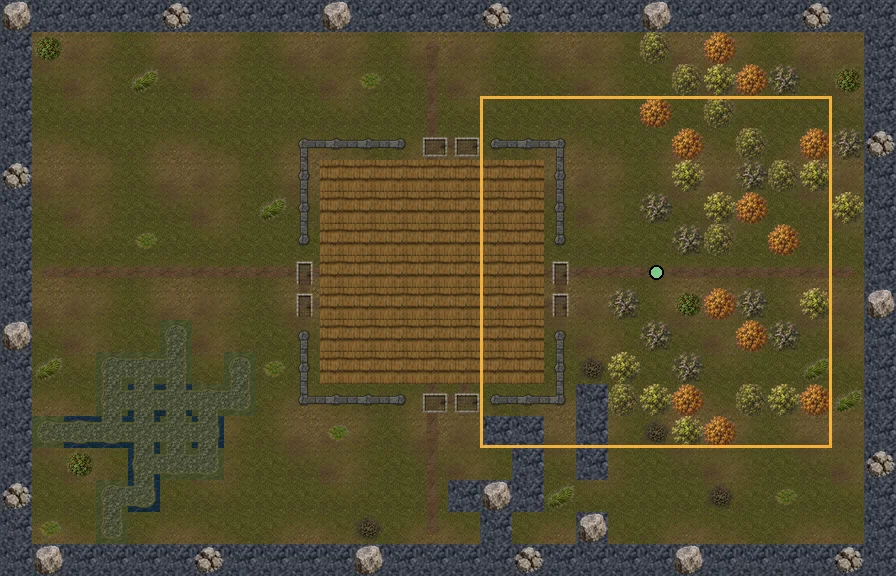
The gold rectangle is the view above; the green dot is you. How much of a region map a player ever sees is an open design question; the play surface stays the vision radius.
The twelve orders that exist in code. Collect is struck out because this square holds nothing; Revive because nobody is down. In the real client every one of these states is the server’s answer, never the interface’s guess.
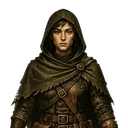
Not the Shard — what the character can see: five squares in every direction, eleven by eleven, the character always dead centre, the whole view always on screen, and everything inside it fully shown. The ground is one continuous meadow — a single sheet baked from the lush and dry grasses and bare earth at full resolution, laid under the whole view — so there is no per-square stamping and no blur; paving, rock and water sit on it as the built and natural exceptions they are. The road and the wall are connectivity pieces chosen by where each continues, computed on the whole map so the road visibly carries on past the view. The hooded scout is you; the wolf and the rat are the real Greenhollow creature tokens — two of only nine assets in the 1,586-piece library that are bound to authoritative content. The gold wash is the gateway at your back.
What in this picture is real, and what is drawn
Real
The terrain. The map generator that runs in development produced this exact grid — walls with real gaps, roads that go somewhere, a lake you cannot walk across — and validated that every open square connects to every other. Every picture on it is the project’s own painted work: the tiles, the trees and shrubs, the props, and the tokens — the wolf and rat are the same art the Greenhollow creature templates bind to. The twelve order names, the queue’s tilde on its predicted Ticks, and the report lines are the real rules’ own wording: a Healing Draught genuinely restores 20 health in the code that exists today.
Drawn
The scene. Where the scout stands, what the wolf is doing, the bandit on the road and the dropped materials are sample data invented for this picture — and outside the two bound creature tokens, every placement is a visual candidate from the library, placed as decoration: art binds nothing, and the terrain underneath stays authoritative for every rule. No Shard runs anywhere, no Tick has ever resolved for a player, and this page cannot ask a server anything — its security policy forbids network connections outright, so the honest failure mode of a page like this pretending otherwise is that the browser refuses loudly.